Whether you are sourcing specialty chemicals for steel production, fertilizer manufacturing, water treatment, or industrial processing, India offers one of the most versatile and competitive chemical supply ecosystems in the world.
But here is the challenge most procurement teams face: the Indian chemical market is vast, diverse, and complex. Navigating it effectively including identifying legitimate suppliers, verifying compliance, negotiating favourable terms, and maintaining consistent supply, requires both market knowledge and ground-level relationships.
This guide is designed to help you do exactly that. From understanding India’s chemical import-export landscape to building a high-performance partnership with a chemical distributor in India, here is everything you need to know before your first purchase order is raised.
What Do Chemical Importers in India Do?
Chemical importers in India occupy a critical position in global industrial supply chains. They source, import, and distribute a wide range of industrial and specialty chemicals, acting as the bridge between international manufacturers and domestic or re-export markets.
Their role typically encompasses:
- Sourcing chemicals from international producers across China, Europe, the US, and other manufacturing hubs
- Handling import documentation, customs clearance, and regulatory compliance
- Quality verification and third-party testing before onward distribution
- Warehousing and inventory management for bulk orders
- Distribution to end-users across sectors including steel, fertilizers, textiles, pharmaceuticals, and water treatment
The best chemical importers in India go beyond logistics where they function as strategic sourcing partners, offering technical guidance on product selection, regulatory interpretation, and supply chain risk management. This distinction between a transactional vendor and a true supply partner is what separates average procurement outcomes from exceptional ones.
Why India Is a Strategic Hub for Chemical Raw Material Sourcing
India’s position as a global chemical hub is not accidental, it is the result of decades of industrial development, strategic trade policy, and deep manufacturing expertise. As a chemical raw material supplier in India, the country serves both as a destination for imported chemicals and as a re-export base for globally distributed supply.
Several structural factors make India uniquely attractive for chemical procurement:
- Geographic Positioning
India sits at the crossroads of major global trade routes, providing efficient access to markets in Southeast Asia, the Middle East, East Africa, and Europe. This location advantage translates into competitive freight rates and faster delivery times for buyers across multiple regions.
- Regulatory Framework
India’s chemical import-export ecosystem is governed by established regulatory bodies including the Directorate General of Foreign Trade (DGFT), the Central Pollution Control Board (CPCB), and international compliance standards such as REACH and RoHS. Working with experienced chemical importers in India means your supply chain operates within a well-defined compliance architecture.
- Diversified Product Portfolio
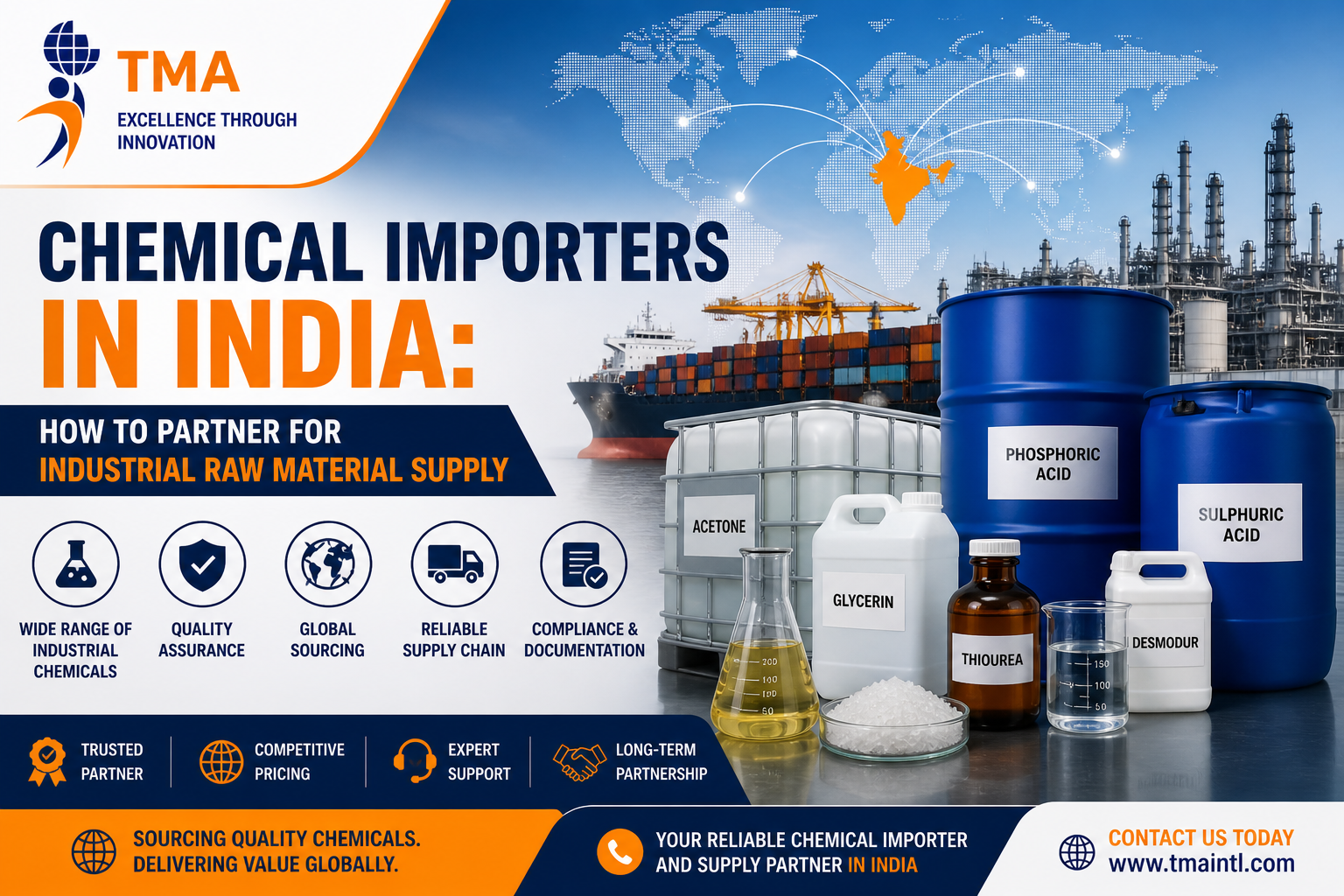
From commodity chemicals like Phosphoric Acid, Acetone, and Glycerin to specialty compounds like Thiourea, Desmodur, and Potassium Amyl Xanthate which is India’s chemical importer network covers a remarkably broad product range. This breadth allows procurement teams to consolidate sourcing with fewer partners, reducing complexity and administrative overhead.
- Competitive Pricing
Competitive domestic logistics costs, a large and skilled workforce, and proximity to Asian manufacturing hubs make India-based chemical distributors consistently price-competitive, without sacrificing on quality or compliance standards.
Key Industrial Chemicals Available Through India-Based Importers
The scope of chemicals that can be sourced through chemical importers in India spans a wide spectrum of industrial applications. Here is an overview of major categories and their industrial relevance:
- Chemicals for Steel and Metal Production
Sourcing through a chemical raw material supplier in India for steelmaking includes materials like Calcined Alumina (used in refractory lining), Phosphoric Acid (for surface treatment), and various process chemicals that support furnace operations and metal finishing.
- Chemicals for Fertilizer Manufacturing
Phosphoric Acid, Sulphuric Acid, and other chemical inputs used in the production of NPK and specialty fertilizers are widely available through established Indian importers, who maintain consistent supply lines from global manufacturers.
- Industrial Solvents and Organic Chemicals
Acetone, Tert-Butyl Alcohol (TBA), Extra Neutral Alcohol (ENA), and Glycerin serve as foundational inputs across pharmaceuticals, cosmetics, paint manufacturing, and chemical synthesis. India-based importers stock these in bulk and can supply to specification.
- Specialty and Mining Chemicals
Potassium Amyl Xanthate (PAX) is a critical reagent in mineral flotation processes used by mining operations globally. Thiourea finds applications in metal surface treatment, photography chemicals, and textile processing.
- Industrial Adhesives and Isocyanates
Desmodur and related isocyanate compounds are essential in polyurethane production for foam, coatings, and adhesives. Sourcing these materials requires strict handling protocols and suppliers who are experienced with hazardous chemical logistics and documentation.
- Lead Compounds and Metal Derivatives
Lead Oxide remains a key input for battery manufacturing and glass production. Reliable industrial chemicals exporters handle these materials with the regulatory diligence required by international environmental standards.
How to Partner with Chemical Importers in India?
Establishing a successful procurement partnership with chemical importers in India is a structured process.
Here is a proven framework:
1. Define Your Chemical Specifications Precisely
Before approaching any chemical distributor in India, document your requirements in full: chemical name, CAS number, purity grade, physical form, packaging type, and any application-specific performance parameters.
2. Verify Supplier Credentials and Compliance
Confirm that the importer holds relevant registrations including import-export code (IEC), GST registration, and any sector-specific licences. For hazardous chemicals, verify that they hold appropriate storage and handling authorisations under the Hazardous and Other Wastes Management Rules.
3. Request Safety and Quality Documentation
A reputable chemical raw material supplier in India will provide a Material Safety Data Sheet (MSDS), Certificate of Analysis (CoA), and Certificate of Origin for every product.
4. Conduct a Technical Evaluation
For first-time or high-volume orders, insist on sample testing before committing. Third-party laboratory analysis provides independent verification of chemical composition and purity thus protecting your production process and downstream product quality.
5. Negotiate Terms for a Long-Term Relationship
Short-term pricing wins rarely outweigh the value of a stable, predictable supply chain. Negotiate with the long game in mind: agree on pricing frameworks tied to market indices, set clear delivery lead times, and establish quality redress clauses that incentivise your supplier to maintain standards consistently.
6. Plan for Regulatory Compliance in Your Market
Your supplier, whether acting as an industrial chemicals exporter or domestic distributor, should be familiar with REACH registration requirements for Europe, EPA standards for the US, and equivalent frameworks for other regions.
Frequently Asked Questions
Q1: How do I identify a legitimate chemical importer versus a broker with no real supply capability?
Look for verifiable infrastructure: a physical warehouse address, import records (searchable via India’s DGFT databases), active IEC registration, and references from existing international clients. A legitimate chemical distributor in India will not hesitate to share this information.
Q2: What are the common challenges when sourcing industrial chemicals from India, and how can I mitigate them?
The most frequent challenges include: inconsistent product quality across batches, delays at customs for non-compliant documentation, and price volatility for feedstock-dependent chemicals. Mitigate these by working with experienced chemical importers in India who have established quality management systems, maintain buffer stock, and have a dedicated team managing regulatory documentation for export shipments.
Q3: Can chemical importers in India supply under an industrial chemicals exporter model for re-export markets?
Yes. Several established chemical importers in India operate as re-export hubs, particularly for markets in Africa, Southeast Asia, and the Middle East. They import from global manufacturers, repackage or blend to specification if required, and export under Indian trade documentation with full compliance support.
Conclusion
At TMA International, we have built our reputation as one of the most dependable chemical importers in India over decades of international trade experience.
What sets TMA International apart as a supply partner:
- Extensive product range covering industrial solvents, specialty chemicals, metal compounds, and processing reagents
- Deep compliance expertise across Indian export regulations and international import standards
- Rigorous quality assurance
- Global distribution capability with proven logistics support across Asia, the Middle East, Africa, and Europe
- A client-first approach that prioritises your supply continuity over short-term transactional wins
- Decades of experience as both a chemical distributor in India and a trusted industrial chemicals exporter
Whether you are sourcing in bulk for the first time or looking to consolidate your chemical supply chain with a single, capable partner, TMA International has the infrastructure and global network to deliver.